
Innovations in Teaching – Learning
1. Virtual lab
Goal:
The goal of implementing a Virtual Lab in the Electronics &Telecommunication Engineering department at Shriram Institute of Engineering & technology (Polytechnic ) Paniv, is to enhance the learning experience by providing a simulated laboratory environment. This innovation ensures that students gain hands-on experience with practical’s, software tools, and computing experiments without being limited by physical infrastructure constraints.
Objectives:
- To provide students with an interactive and accessible laboratory experience.
- To enhance learning flexibility by enabling students to perform experiments anytime, anywhere.
- To reduce dependency on hardware resources and physical laboratory space.
- To integrate real-world simulation tools to improve conceptual understanding.
Application:
1.Programming : Students can practice coding /practice in multiple languages (Keil, Proteus, Python, etc.).
2.Database Management: Virtual lab setups for SQL-based learning and database design.
3.To enhance the scope in industry & sophisticated interact with the industry environment.
4.Machine Learning & Artificial Intelligence: Online AI/ML tools for research-oriented projects.
Utilization:
-Integrated into assignments and projects for real-time experimentation.
-Supports online and hybrid learning models by allowing remote access to virtual tools.
-Used for skill development and certification preparation through interactive learning modules.
Implementation:
- Integration with Course Curriculum:
-Practical assignments are designed to be performed using Virtual Labs.
-Faculty members provide demonstration sessions and guided tutorials.
-Online assessments and project evaluations are conducted using virtual environments.
- Student Training & Engagement:
-Hands-on workshops on the usage of virtual tools.
-Encouraging students to complete real-world projects using Virtual Labs.
-Feedback mechanism to improve the effectiveness of the implementation.
Benefits:
1.Increased Accessibility: Students can conduct experiments from home without lab restrictions.
2.Improved Learning Flexibility: Learning is self-paced, and students can repeat experiments multiple times.
3.Efficient Resource Utilization: Reduces dependency on physical hardware and costly software.
4.Industry Relevance: Exposure to cloud-based platforms prepares students for real-world IT environments.
5.Encourages Innovation: Students can explore new technologies beyond classroom limitations.
Effectiveness:
1.Student Usage Statistics: Number of students regularly use virtual lab environments for assignments and practice.
2.Project Outcomes: Several final-year projects have successfully integrated virtual lab-based implementations.
3.Feedback from Students & Faculty:
Students will get a feel of the real lab, as all lab equipment, components and lab behavior would be mimicked in the system.
Conclusion:
Virtual labs can be used in electronics to teach and learn about circuits, components, and other concepts. They can also help students develop practical skills. has significantly enhanced the teaching-learning process, students gain a flexible, accessible, and industry-relevant practical learning experience. The continuous improvements in Virtual Lab infrastructure and teaching methodologies will further enhance its impact, making it an essential part of modern engineering education.
Sr.No. | Lab Name | Link |
1 | Analog and Digital Electronics Lab I (New)
| |
2 | Analog and Digital Electronics Lab II (New)
|
https://ade2-iitr.vlabs.ac.in/ |
3 | Analog Electronics Circuits Virtual Lab
| https://aec-iitkgp.vlabs.ac.in/ |
4 |
| https://ae-iitr.vlabs.ac.in/ |
5 |
| https://be-iitkgp.vlabs.ac.in/ |
6 |
| https://da-iitb.vlabs.ac.in/ |
7 | Digital Electronic Circuits Lab
| https://dec-iitkgp.vlabs.ac.in/ |
8 |
| https://de-iitr.vlabs.ac.in/ |
9 |
| https://de-iitg.vlabs.ac.in/ |
10 | Digital Logic Design Lab (Logic Gates & Mux-Demux)
| https://dld-iitb.vlabs.ac.in/ |
11 | Embedded System Design with 8051 and PIC Microcontrollers (New)
| https://esd-coep.vlabs.ac.in/ |
2. Seminars
- Introduction
In today’s rapidly evolving technology landscape, practical exposure to industry-standard software & hardware tools is essential for Electronics & telecommunication Engineering students. While theoretical knowledge forms the foundation of engineering education, hands-on experience bridges the gap between academic learning and real-world industry expectations.
Electronics & telecommunication Engineering at Shriram Institute of Engineering & technology (polytechnic) Paniv has introduced Hands-on Training Workshops as an innovative teaching-learning methodology. These workshops equip students with practical skills, enhance their proficiency in software tools, and improve their readiness for industry roles.
- Statement of Clear Goal
The primary goal of implementing Hands-on Training Workshops is to:
- Bridge the gap between theory and practice, allowing students to apply classroom concepts to real-world scenarios.
- Prepare students for industry expectations by exposing them to widely used Hardware tools and development environments.
- Enhance problem-solving and debugging skills through hands-on exercises.
- Foster an industry-oriented learning approach, making students more competitive in placements and internships.
- Use of Appropriate Methods
To achieve the above objectives, the following methodologies are employed in Hands-on Training Workshops:
- a) Industry-Standard Software & Hardware Training Workshops:
Regular training sessions on essential software tools such as:
- Machine Learning & AI: Tensor Flow, Open CV, NLP Libraries.
- IoT and Embedded Systems: Arduino, Raspberry Pi.
- b) Guest Lectures from Industry Professionals:
- Experts from Robotics companies, startups, and research institutions share insights on industry practices.
- Discussions on emerging trends, software engineering best practices, and career guidance.
- c) Practical Implementation & Live Projects:
- Students participate in real-world projects exercises, mini-projects, and industry-inspired assignments.
- Workshops are designed to encourage hands-on practice, debugging, and solution-building.
- d) Collaborative Learning & Peer Reviews:
- Students work in teams on projects, promoting teamwork.
- Peer assessments and mentor evaluations ensure interactive learning.
- e) Significance of Results
The introduction of Hands-on Training Workshops has resulted in:
a)Improved Hardware interfacing Proficiency:
Students gain hands-on experience with industry-standard tools and technologies.
b) Development of Practical Skills:
Application-based learning ensures students can implement concepts effectively.
c) Increased Industry Readiness:
Workshops align with job market requirements, making students better prepared for placements and internships.
d) Higher Placement Success:
Graduates with hands-on project experience stand out in campus recruitment drives.
e) Stronger Problem-Solving Abilities:
Real-time debugging and troubleshooting activities improve logical thinking.
- Effectiveness Evaluation
The effectiveness of Hands-on Training Workshops is measured using various assessment techniques:
- a) Pre- and Post-Workshop Assessments:
- Students undergo a baseline test before training and a final assessment after completion.
- Improvement in , debugging skills, and problem-solving is recorded.
- b) Student Feedback Surveys:
- Feedback is collected to assess the impact and quality of workshops.
- Suggestions for enhancing learning outcomes are considered for future sessions.
- c) Project-Based Evaluations:
- Faculty assesses student projects based on innovation, code quality, and real-world application.
- d) Placement and Internship Tracking:
- Success rates in internships and job placements are monitored to measure industry readiness.
- e) Participation in Competitions:
- Student involvement in project exhibition competitions, and industry certifications serves as an indicator of their skill development.
- Hands-on Training
Workshops at Shriram Institute of Engineering & technology (polytechnic )paniv
- a) Robotics workshop :
- Objective: Teach Robot fundamentals .
- Outcome: Students built Robot -based projects
- b) Develop New project ideas :
- Objective: Introduce students to Industry environment.
- Outcome: Students successfully Prepare new projects related to industry.
- Conclusion
The implementation of Hands-on Training Workshops in the Electronics & telecommunication Engineering at Shriram Institute of Engineering & technology (polytechnic) Paniv, has significantly improved student engagement, technical proficiency, and industry preparedness.
By integrating real-world software tools, industry expert sessions, and project-based learning, students gain practical skills essential for their careers. Moving forward, expanding these workshops with AI-driven learning modules, virtual labs, and global certification programs can further enhance learning outcomes and placement success rates.
3.MSBTE -E contents
Link- https://econtent.msbte.edu.in/econtent/econtent_home.php
Msbte video lectures:- https://msbte.ac.in/msbteVideoLectures
4. Training Programs
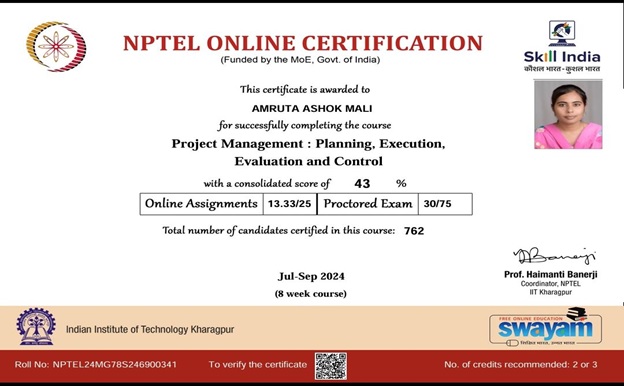
- National Program on Technology Enhanced Learning (NPTEL) courses:
Goal:
The objective of integrating National Program on Technology Enhanced Learning (NPTEL) courses into the Computer Engineering curriculum at Zeal College of Engineering and Research, Pune, is to supplement traditional classroom learning with high-quality online resources from IITs, IISc, and other premier institutions. By leveraging NPTEL, students gain access to expert lectures, certification opportunities, and self-paced learning modules, enhancing their conceptual understanding and practical skills.
Objectives:
- To provide students with access to high-quality technical contentdeveloped by premier institutions.
- To supplement the curriculumwith additional resources beyond classroom teaching.
- To encourage self-paced learning and upskillingamong students.
- To prepare students for competitive exams, industry certifications, and job-oriented skill development.
- To integrate NPTEL courses with the existing course structure and credit-based learning system.
Utilization:
- NPTEL as a Supplementary Learning Tool: Integrated into practical assignments, mini-projects, and subject coursework.
- Blended Learning Approach: Students attend classroom lectures and refer to NPTEL videos for deeper understanding.
- Credit-based Learning: NPTEL certification courses are considered for additional credits, internships, and placements.
- Faculty-Led Learning Initiatives: Faculty members guide students on course selectionand monitor progress and completion rates.
- Discussion Forums & Doubt Clearing: Students engage in NPTEL forums and faculty-led discussionsto resolve queries.
Implementation:
- Identification of Relevant Courses
- Faculty selects NPTEL courses aligned with the Electronics & Telecommunication Engineering syllabus.
- Courses mapped to Data Science, AI, IoT, and core Electronics & Telecommunication Engineering subjects.
- Student Enrollment & Engagement
- Students are encouraged to register for relevant courseseach semester.
- NPTEL’s online video lectures, quizzes, and assignmentsare used for learning assessments.
- Faculty Monitoring & Mentorship
- Faculty members monitor student progress and provide additional guidance.
- Doubt-solving sessions are conducted to ensure concept clarity.
- Certification & Recognition
- Students earn NPTEL certificatesafter successful completion and exams.
- Certifications are considered during placement drives and project evaluations.
Benefits:
- Access to High-Quality Learning Material: Expert lectures from IITs, IISc, and industry professionals.
- Flexible & Self-Paced Learning: Students can learn at their convenience, anytime, anywhere
- Skill Enhancement & Industry Relevance: Helps students upskill with in-demand technologies.
- Boosts Employability: Recognized NPTEL certifications add value to resumes.
- Prepares Students for Competitive Exams: NPTEL courses align with GATE and other technical exams.
- Encourages Research & Innovation: Advanced courses support project-based learning and research.
Effectiveness:
- Student Enrollment & Completion Rates:
- Over 150+ studentshave completed NPTEL courses in the last academic year.
- High participation in courses related to Project management
- Feedback on NPTEL Content:
- 92% of studentsfound NPTEL courses beneficial for deeper understanding.
- Faculty membersreport improved student performance and engagement.
- Integration with Curriculum:
- NPTEL courses are mapped to core and elective subjects.
- Students use NPTEL resources for assignments, projects, and case studies
Conclusion:
The integration of NPTEL courses into the Electronics & Telecommunication Engineering curriculum at Shriram Institute of Engineering &Technology (Poly), Paniv has proven to be a successful innovation in teaching and learning. By providing students with high-quality learning resources, industry-relevant knowledge, and certification opportunities, this initiative has enhanced the academic experience and employability of students. Moving forward, a structured credit-based system for NPTEL courses can further motivate students to engage in lifelong learning and skill development
5.Add-on Programs / Certification